Archive for
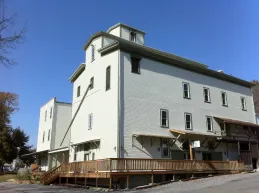
The fourth floor of the Mill has a sign that says “You made it to Texas”. We don’t know why but the story is that it was hot there too. It’s also true that the oil fields moved from Pennsylvania to Texas. The big flywheel was originally driven by belts from the basement and later by an electric motor in Texas. It in turn drives a chain that drives the grain elevators. The small selector pictured shows how the larger one on the fifth floor works. The turn wheel on the first floor turns the selector in Texas and selects the chute. There are many of these smaller selectors all over the mill.


One of the first things the Mill needed was a new roof. Joe Hanna, his sons and other helpers worked diligently through the Fall of 2008 to put a new roof and siding on the fourth and fifth floors of the Mill. We used pink board to insulate the roof and then added metal. The new windows were hoisted by hand.


I’m going to start a new series today called the Mill Top to Bottom. So we will start with the fifth floor which is where the selector for the two main grain elevators was located. The grain traveled up to the fifth floor and there the miller selected which of 14 chutes it would be routed to using the turn wheel on the first floor. Also pictured is Joe Hanna adding a new roof to the very top of the Mill in October of 2008.


In 2012 we added a Yamaha CP33 stage piano and Yamaha self powered speakers so that we could do concerts inside the Mill. Before this we had to borrow a piano from the Lighthouse church at the Mill or from Chapel on the Hill church. This was also the year that Julie introduced Friday night for pay concerts which were outstanding. We would house touring musicians in the Bunkhouse and they would provide a concert. You will also notice Nancy’s feed sack display hanging from the ceiling. Everyone enjoyed the backdrop of the Mill machines.


2011 was also the first year for the “February Album Writing Month” FAWMstock at the Mill. We hosted musicians and singer/songwriters from all over the world. They spent four days at the mill, sleeping (infrequently) in the bunkhouse, writing original music and on Saturday they gave a concert that ran past midnight. The third floor was turned into a recording studio by the Canadian contingent using equipment Devin brought across the border.


In 2011 we added a Presonus 16-4-2 board to the Mill. I built a custom cart to hold the stands, mikes, cables, board and computers. This made it much easier to set up a concert. The Presonus board could be remotely run from an Ipad which made it fun.


We started having Saturday night concerts at the Mill in June of 2009 as soon as we had the patio finished. As I remember, there was only one stairway finished and the planter wasn’t even constructed. The Lowrys and the Shegogs not only scooped ice cream but played the music. By July the thrust and planter were finished and the fish was in place. Darlene scheduled the music and the bands brought their own sound systems. We borrowed the piano from the Lighthouse church that met in the Mill for some concerts. By the Spring of 2010, the bunkhouse was open and we added a sound system to the patio using four outdoor speakers a small Alesis Multimix mixer and a home stereo amplifier. The siding was finished by the fall of 2010.


Here is a quick rundown of the equipment in the Grain Bin Studio. The speakers are Acoustic Research AR3a. The tape recorder is a four track Teac using quarter inch magnetic tape. To the right of the recorder is a hundred watt lunchbox amplifier designed by Stan Kriz. To the left is the meter head/power supply/headphone amplifier for the board. I built the mixing board by hand out of Aluminum stock. The electronics which is all rack mountable includes compressors, Stan’s 90db version of a dolby unit, reverbs, and matrixes. The center section originally held the board at the left and then later held the Teac board. the red back board is from a Three Rivers Computer booth. The tall rack holds the WRCT green machines that provided late night music. Originally it was a data logger from the Pittsburgh airport. The small rack is the six track recorder, Ampex deck and electronics. The poster is a Maxfield Parrish that hung in the original CMU studio.


The CMU Fine Arts recording studio primarily recorded recitals in Exhibition Hall and made audition tapes for the music students. But when the musicians played at Pittsburgh’s Carnegie Music Hall or the Carnegie Lecture Hall in Oakland, we also recorded there. One night, we were asked to record a harp recital for Marcella Kosikova and she asked if we could carry her harp on and off stage between pieces so she could retune it. Since we had friends that did silk screening, we created the Ace Harp Movers shirt with the logo “You pluck it, We truck it”. Marcella received one of the shirts and was very pleased and I understand shirts with the logo were seen around the Carnegie Mellon campus for many years after our initial run.

Here is a quick story about the 1969 Rolling Stones Tour. I was working for the CMU Computer Science Department in Porter Hall and living with two engineers Bob Nickau and Roland Findlay. We knew Chris Langhart from the CMU radio station WRCT and when he was picked to do the sound for the Stones tour he called on Bob to handle the amplifiers because they were using solid state amplifiers for the first time. Five days into the tour, Bob called and asked me to join the crew. He said there was a ticket for me to Phoenix at the airport for the next morning and to travel light because I was carrying the oscilloscope. Since the banks were already closed, Roland opened the Porter Hall Coke machine and lent me a few rolls of quarters for spending money. I packed my things in my attache case and left for a really fun tour. The night I arrived the Stage Manager told me he was leaving the tour to work for Country Joe and the Fish and I would be in charge of the stage miking. That was my total apprenticeship for the tour. Chuck Berry and Ike and Tina Turner were also on the show. We got very little sleep because there was only one sound crew and a new concert in a different state each night. I didn’t care, this was the tour of a lifetime. The button in the photo was our back stage pass.


 The Emlenton Mill