Posts tagged ‘Emlenton Mill’
One of the first things the Mill needed was a new roof. Joe Hanna, his sons and other helpers worked diligently through the Fall of 2008 to put a new roof and siding on the fourth and fifth floors of the Mill. We used pink board to insulate the roof and then added metal. The new windows were hoisted by hand.


In 2012 we added a Yamaha CP33 stage piano and Yamaha self powered speakers so that we could do concerts inside the Mill. Before this we had to borrow a piano from the Lighthouse church at the Mill or from Chapel on the Hill church. This was also the year that Julie introduced Friday night for pay concerts which were outstanding. We would house touring musicians in the Bunkhouse and they would provide a concert. You will also notice Nancy’s feed sack display hanging from the ceiling. Everyone enjoyed the backdrop of the Mill machines.


2011 was also the first year for the “February Album Writing Month” FAWMstock at the Mill. We hosted musicians and singer/songwriters from all over the world. They spent four days at the mill, sleeping (infrequently) in the bunkhouse, writing original music and on Saturday they gave a concert that ran past midnight. The third floor was turned into a recording studio by the Canadian contingent using equipment Devin brought across the border.


In 2011 we added a Presonus 16-4-2 board to the Mill. I built a custom cart to hold the stands, mikes, cables, board and computers. This made it much easier to set up a concert. The Presonus board could be remotely run from an Ipad which made it fun.


We started having Saturday night concerts at the Mill in June of 2009 as soon as we had the patio finished. As I remember, there was only one stairway finished and the planter wasn’t even constructed. The Lowrys and the Shegogs not only scooped ice cream but played the music. By July the thrust and planter were finished and the fish was in place. Darlene scheduled the music and the bands brought their own sound systems. We borrowed the piano from the Lighthouse church that met in the Mill for some concerts. By the Spring of 2010, the bunkhouse was open and we added a sound system to the patio using four outdoor speakers a small Alesis Multimix mixer and a home stereo amplifier. The siding was finished by the fall of 2010.


Here is a quick rundown of the equipment in the Grain Bin Studio. The speakers are Acoustic Research AR3a. The tape recorder is a four track Teac using quarter inch magnetic tape. To the right of the recorder is a hundred watt lunchbox amplifier designed by Stan Kriz. To the left is the meter head/power supply/headphone amplifier for the board. I built the mixing board by hand out of Aluminum stock. The electronics which is all rack mountable includes compressors, Stan’s 90db version of a dolby unit, reverbs, and matrixes. The center section originally held the board at the left and then later held the Teac board. the red back board is from a Three Rivers Computer booth. The tall rack holds the WRCT green machines that provided late night music. Originally it was a data logger from the Pittsburgh airport. The small rack is the six track recorder, Ampex deck and electronics. The poster is a Maxfield Parrish that hung in the original CMU studio.


Nancy and I were married in 1979 and soon after we moved the CMU Fine Arts Studio to the basement of our house two blocks from CMU. We divided the basement into two rooms connected by a double glass window. We added a Teac board and a Roland piano. This was the last iteration of the studio before it moved to the grain bin at the Emlenton Mill. My friends Brian Rosen and Stan Kriz from the studio and I started Three Rivers Computer Company and soon we were all too busy with the company and children to play in the studio any longer.


My son, David, suggested that I write a blog about the Emlenton Mill and since this is February I thought I would start by writing about sound and recording, which I love. February, you see, is the month of FAWM (February Album Writing Month). For more information check out http://www.fawm.org. I figure that writing a blog every day is a little like writing a song every other day, except much easier. So, welcome to the Emlenton Mill blog. I’ll try to work in the Mill along with my love of recording.
The Emlenton Mill, built in 1875, houses a mill museum, an ice cream shop, a bunkhouse hostel, an Emporium that sells antiques, crafts and books and a number of secrets. One of these secrets is a recording studio in a gain bin.
Hidden away in a converted grain bin, on the third floor of the Mill, is a recording studio control room from the 1970s. It was originally located on the music practice floor of the College of Fine Arts at Carnegie Mellon University. It was built by myself and some friends from the campus radio station WRCT. But more about that another day. The Mill has a large number of grain bins which were used to store the different grains that were processed at the Mill. They vary in size from the size of a closet to the size of a railroad box car. The grain bin we chose for the studio is a small room located just off the main area of the third floor and required very little alteration. Most grain bins are built with sloped floors so the grain would gravity feed to the center of the bin where the output chute was located. This grain bin only required a new floor to support the studio.


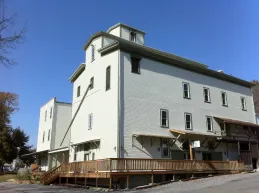
 The Emlenton Mill